
US citizens can legally marry in Italy in a civil ceremony or a Roman Catholic wedding after swearing a Dichiarazione Giurata (often called the nulla osta) before a U.S. consular officer in Italy, having it legalized at the local Prefettura, and presenting an Atto Notorio and an apostilled birth certificate translated into Italian to the Marriage Office of the town hall. According to the U.S. Embassy & Consulates in Italy, a marriage that is valid in Italy is automatically valid in the United States, yet 65.4% of foreign couples who wed in Italy choose a symbolic ceremony instead (Convention Bureau Italia, 2025 report).
If you are figuring out how to get married in Italy as a US citizen, you are in good company. The United States accounts for 31.7% of all destination wedding requests in Italy, and Rome hosted 750 destination weddings in 2025, up 7.8% over the year before, according to Rome’s tourism councilor, Alessandro Onorato, at the report’s presentation on February 18, 2026. The process is not hard, but it is precise: the right documents, in the right order, within the right time window. This guide walks you through each path using only official sources.
Once the paperwork is mapped out, the real question is where to celebrate. That is exactly the problem Villa Dafne Majestic solves: a historic villa in northern Rome, 20 minutes from the city center and reserved exclusively for your celebration, where a symbolic ceremony in the gardens flows straight into cocktail hour, dinner, and dancing, with one team coordinating the timing around whichever legal path you choose.
Can Americans Get Legally Married in Italy? Civil vs. Symbolic Ceremonies
Yes. Italian law gives Americans two ways to leave Italy legally married, plus a third way to celebrate in Italy while the legal formality happens at home. The first is a civil ceremony, performed by the mayor or a deputy at a venue authorized by the town. The second is a Roman Catholic wedding: the U.S. Embassy notes that a ceremony performed by a Catholic priest is legally valid on its own, because the priest registers the marriage with the civil authorities, while the Church also asks for baptismal and confirmation certificates. For English-language weddings at the Vatican, the Embassy points couples to Saint Patrick’s, the American parish in Rome. By contrast, the Embassy adds, a religious ceremony led by non-Catholic clergy must be preceded by a civil ceremony to be legally binding.
The third way is the symbolic ceremony, which has no legal effect on its own: you sign your marriage license in the US and celebrate in Italy exactly as you wish. So, is it hard for an American to get married in Italy? Not really. The civil and Catholic routes share the same core paperwork, and that is where most couples simply need a clear map.
The Civil Ceremony in Rome, Step by Step
Requirements come from Italian law and apply nationwide, but the U.S. Embassy’s official guidance cautions that town halls may interpret them slightly differently, so confirm the final list with the Marriage Office where you will marry. In Rome, the sequence looks like this.
Step one, at home: order a certified copy of your long-form birth certificate, the version that lists both parents, and have it apostilled by the Secretary of State of the state where you were born, per the Italian consulates in New York and Miami. If you were married before, add the final divorce decree or your former spouse’s death certificate, also apostilled. Brides whose previous marriage ended within 300 days also need a waiver from the Procura della Repubblica where they marry, the Embassy adds. Every document must be translated into Italian; a divorce decree needs a professional translation, apostilled too, per both consulates. Timing matters: under Italian law, documents issued outside the EU are valid for only six months, so for a wedding on June 12, 2027, nothing you submit should be issued before December 12, 2026.
Step two, the Atto Notorio: witnesses who know you swear that nothing prevents you from marrying. The Embassy recommends getting it from the Italian consulate serving your state before you fly, because some Italian courts have long waiting lists. Rules differ by consulate, so check yours: New York asks for four unrelated witnesses and an affidavit executed within three months of the wedding date, while Miami describes two witnesses and a document valid for 90 days. In Rome, the alternative is the Atto Notorio office of the Tribunale Ordinario, with two witnesses, an interpreter if anyone does not speak Italian, and a pickup the Embassy says generally takes four to 10 days.
Step three, the Dichiarazione Giurata: once in Italy, you swear before a U.S. consular officer that no legal impediment exists under the laws of your home state. In Rome, that means an appointment at the U.S. Embassy on Via Vittorio Veneto. Fill out the form beforehand, but sign it only in front of the officer. Step four: take the declaration to the Legalization Office of the Prefettura di Roma, with a revenue stamp (marca da bollo) from any tabacchi for each document.
Step five: bring everything to the Marriage Office of Rome City Hall on Via Petroselli to make your declaration of intention to marry, with an interpreter if you do not speak Italian; only then can you set the date. Banns are normally waived or shortened for couples who are neither Italian citizens nor residents. Step six, the ceremony: Turismo Roma, the city’s official tourism site, lists three institutional halls: the Sala Rossa on Piazza del Campidoglio, overlooking the Roman Forum and seating 20 guests; the Complesso di Vignola Mattei, a sixth-century former church beside the Baths of Caracalla, seating 25; and the Sala Azzurra in Ostia. You need two witnesses over 18 with photo ID, and a witness cannot double as your interpreter. Step seven: before flying home, request a copy of your marriage certificate and have it apostilled at the Prefettura. For anything unusual, the Embassy suggests asking an Italian consular officer, the civil registrar, or a lawyer licensed in Italy.
The Symbolic Ceremony: Married at Home, Celebrated in Italy
There is a reason the symbolic ceremony is the most popular format among foreign couples in Italy, ahead of civil and religious rites, in the Convention Bureau Italia report: it frees you from every Italian office, appointment, and stamp. You get legally married at home, often in a small courthouse or county clerk ceremony, and in Italy you celebrate the wedding you have been dreaming of. Check with your county clerk how long the license stays valid and whether a waiting period applies.
Is a symbolic wedding legal? Not on its own, and that is precisely its strength. With no registrar and no legal script to follow, you choose the hour, the language, the officiant, and every word. You can write your own vows, ask a friend to officiate or work with a professional celebrant, add a sand, unity candle, or wine ceremony, have letters read aloud, and fill the garden with live music. Time it for golden hour, when the light over Rome turns warm.
Many couples simply tell their guests it is their wedding, because emotionally it is. Some share the courthouse photos at the welcome party; others keep the legal signing private. A symbolic ceremony is also different from a vow renewal: a vow renewal reaffirms a marriage that already exists, while a symbolic wedding is the first time you say “I do” in front of the people you love, with the legal formality handled quietly elsewhere. For many American couples, it is the cleanest answer to the question of how to get married in Italy without letting paperwork set the schedule.
Planning Your Rome Wedding from the US: Timeline, Guests, and Venue
Planning from thousands of miles away works best backward from your date. Start with the decision that shapes everything else: civil, Catholic, or symbolic. Then lock in your venue and date, especially if you are eyeing May, June, or September, the months the U.S. Embassy flags for waiting lists at Italian town halls. The calendar is widening, though: the Convention Bureau Italia report notes that while summer still dominates, the share of weddings in the last quarter of the year has grown noticeably, and a venue with indoor salons makes a fall or winter celebration feel just as complete.
With the date set, the document clock starts. Order apostilled birth certificates no more than six months before the wedding, book your Atto Notorio within your consulate’s window, and, if you are marrying civilly in Rome, arrive with time to spare: the Embassy warns that you may need several days to complete the procedures. Nearly half of foreign couples, 46.8% according to Convention Bureau Italia, hire a professional wedding planner to manage this sequence.
Then think like your guests. A day that unfolds in one place, with clear directions and private parking, feels effortless; a day split between a downtown hall and a reception elsewhere needs careful timing to keep the magic intact. Many couples build a full wedding weekend around the ceremony, with a welcome party, a rehearsal dinner, and a farewell brunch, and save the Eternal City for photos and sightseeing in between.
How Villa Dafne Majestic Makes It Simple
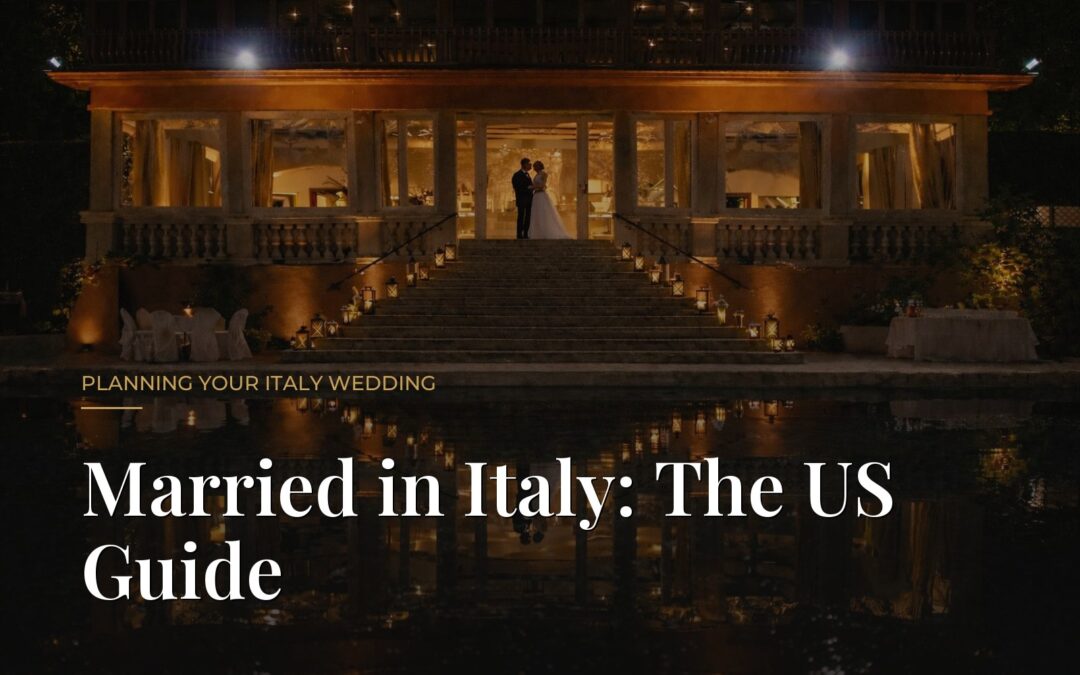
Villa Dafne Majestic is a historic villa in northern Rome, 20 minutes from the city center and just minutes from the GRA, Rome’s beltway, reserved exclusively for one celebration at a time. Your symbolic ceremony can unfold in the panoramic gardens, with the reception just steps away: cocktail hour by the pool, then dinner and dancing, prepared by the in-house catering team with a dedicated chef and styled by the villa’s custom event design team, with the historic salons ready in every season. If you want your marriage to be legally binding in Italy, the civil ceremony takes place at a venue authorized by the City of Rome, such as the Sala Rossa at the Campidoglio, and the villa’s team coordinates the timing so your guests move seamlessly to the reception, where private parking for more than 200 cars is waiting.
Here is how it works. First, check availability for your date. Next, schedule a video call with the villa’s team to talk through your vision and the legal path you have chosen. Then plan your visit: an in-person site visit when you are in Rome, or a virtual tour from home. You receive a written proposal tailored to your celebration, and from there you plan every detail with the team, from the ceremony setup to the last toast.
Frequently Asked Questions
Are you legally married in the US if you get married in Italy?
Yes, as long as the marriage is valid in Italy. The U.S. Embassy & Consulates in Italy state that a foreign marriage valid where it is performed is automatically valid in the United States, and that an Italian marriage certificate is sufficient proof once it is legalized with an apostille. Before leaving Italy, request a copy of your certificate from the town hall and have it apostilled by the Legalization Office of the Prefettura covering the place where you married. A symbolic ceremony has no legal effect, so the legal part happens in the US.
How long do you have to be in Italy before getting married?
Neither the U.S. Embassy nor the Italian consulates in New York and Miami list a residency requirement, and banns are waived or shortened for couples who are neither Italian citizens nor residents. What takes time is the paperwork in Italy: the sworn declaration at the U.S. Embassy or a consulate, its legalization at the Prefettura, and the declaration of intention to marry at the town hall. The Embassy advises that you may need several days to complete these procedures and that waiting lists are common in May, June, and September, so arrive with time to spare.
Can you get married outside city hall in Italy?
Yes, within limits. Under Italian law (Presidential Decree No. 396 of 2000), a town can designate venues beyond its city hall as separate civil registry offices, so a legally binding civil ceremony must take place at a venue the municipality has authorized. In Rome, the city's official tourism site lists the Sala Rossa at the Campidoglio, the Complesso di Vignola Mattei, and the Sala Azzurra in Ostia. A Catholic wedding is celebrated in church, while a symbolic ceremony can be held wherever you like, including the gardens of a private villa.
Can Villa Dafne Majestic help us plan our Italy wedding from the US?
Yes. The team at Villa Dafne Majestic plans your celebration with you, even from afar, and works hand in hand with your own wedding planner if you have one. Start by checking availability for your date, then schedule a video call to share your vision and the ceremony you have in mind. You can visit in person or take a virtual tour, receive a written proposal tailored to your celebration, and plan everything with the team, including the timing between your ceremony and the reception. Request a proposal through the contact page.
The paperwork is a sequence of precise, well-documented steps; the celebration is where Rome should take your breath away. Whether you sign at a Roman municipal hall or at a courthouse back home, Villa Dafne Majestic gives your celebration a private setting in northern Rome, reserved for you alone: gardens for your ceremony, a pool and historic salons for every season, and one team at the helm from the first call to the last dance.
Ready to start? Check availability for your 2027 date, schedule a video call with the villa’s team, and request a proposal. Then plan your visit, in person or virtually.